
on edge and max extracting
"put all your eggs in one basket and watch the basket carefully"

my friend runs a tiktok account. it posts hair content, and has 22,000 followers. well, these days, runs is a bit of an overstatement. he hasn’t posted for nearly a month. at his peak, however, he was making north of $4,500 a month just from sponsors at 17. how was this possible?
when he started, he was making nothing, but as he grew, sponsors quickly noticed. at this time, the tiktok hairstyle content creator industry was quite empty, and there were a lot of newer hair brands willing to pay handsome amounts to creators to promote their products. the rates were ridiculously high as the companies were trying to quickly scale and had money to throw around, and the lack of hair creators to sponsor meant those who had some following could command high sponsorship amounts. at one point, one specific company was paying my friend (who at the time, had roughly 15000ish followers), $120 per video (total $3000/month). keep in mind these videos are on average, 20-30 seconds long. at one point, my friend actually stopped bothering to accept more sponsors offering him lower rates like $25 per video, despite the fact that these videos would take mere minutes to film.
the market dynamics that allowed this were not meant to last forever. the free market has a funny way of letting edges decay and letting arbs be filled. more creators entered, the hair brands grew. slowly, my friend lost his negotiating power. unfortunately, he didn’t realise till it was too late. as the quote goes, he lost it gradually, then all at once. smaller companies stopped sponsoring him, perhaps they realised the unviability of giving so much to a creator so relatively small, or they just could not afford it. his main sponsor kept paying though, and renewed him for another 6 month contract, at the same rate. this contract ended recently, and when renegotiating, they informed him his new rate would be $1000/month. he rejected this, telling me that rate was “just insulting.”
i don’t think he has yet grasped that the marketplace dynamics have firmly changed. that company has grown significantly, his following has stagnated. they sponsor more creators now, they are in physical stores, he is just one of hundreds of creators now. the free money era of that niche is over. recognising you have edge and the type it is can be just as important as having it in the first place.
these dynamics are not idiosyncratic to my friends tiktok experience. moving to a domain more closely related to trading, like poker, we can draw similar parallels. in poker, outcomes are distributed along power laws. the top 20 starting hands capture 88.6% of the positive EV in the game, whilst the remaining 149 start to bleed it all back. the top 5 hands capture 51.1%1 of all positive ev in the game. hence, edge in poker can thought of as a process edge, such as playing high ev initial hands whilst folding hands which bleed ev, or being able to exploit specific opponents.
edge in poker can also be structural. table selection in poker is very important. you can be the 10th best in the world at poker, but if playing on a table with ranks 1 through 5, you will still bleed. conversely, you could just know basic poker gto, but if you are on a table playing against drunkards, it is likely you will win. micheal platt said he once hired someone “who gets up at seven o’clock on Sunday morning when his kids are still in bed, and logs onto a poker site so that he can pick off the U.S. drunks coming home on Saturday night.” by selecting a good table to play on, you can gain structural edge. this is similar to what my friend experienced on tiktok, an edge gained from broader marketplace or environment dynamics rather than a specific repeatable action, process or understanding from you.
i believe that, when presented with an asymmetric opportunity, when you have some edge, you should be max allocating2 to that opportunity in order to max extract. why allocate capital3 to your second or third best idea when you can allocate more to your best idea? as druckenmiller puts it, “a traders job is to recognise when they have a hot hand and size up accordingly.” soros provides a clear example of this mindset; in 1992 when druckenmiller told soros he wanted to short 100% of the fund against the pound, soros looked at him with disdain. he thought that the opportunity was so compelling, such a “once in a generation opportunity” that they should be short 200%.
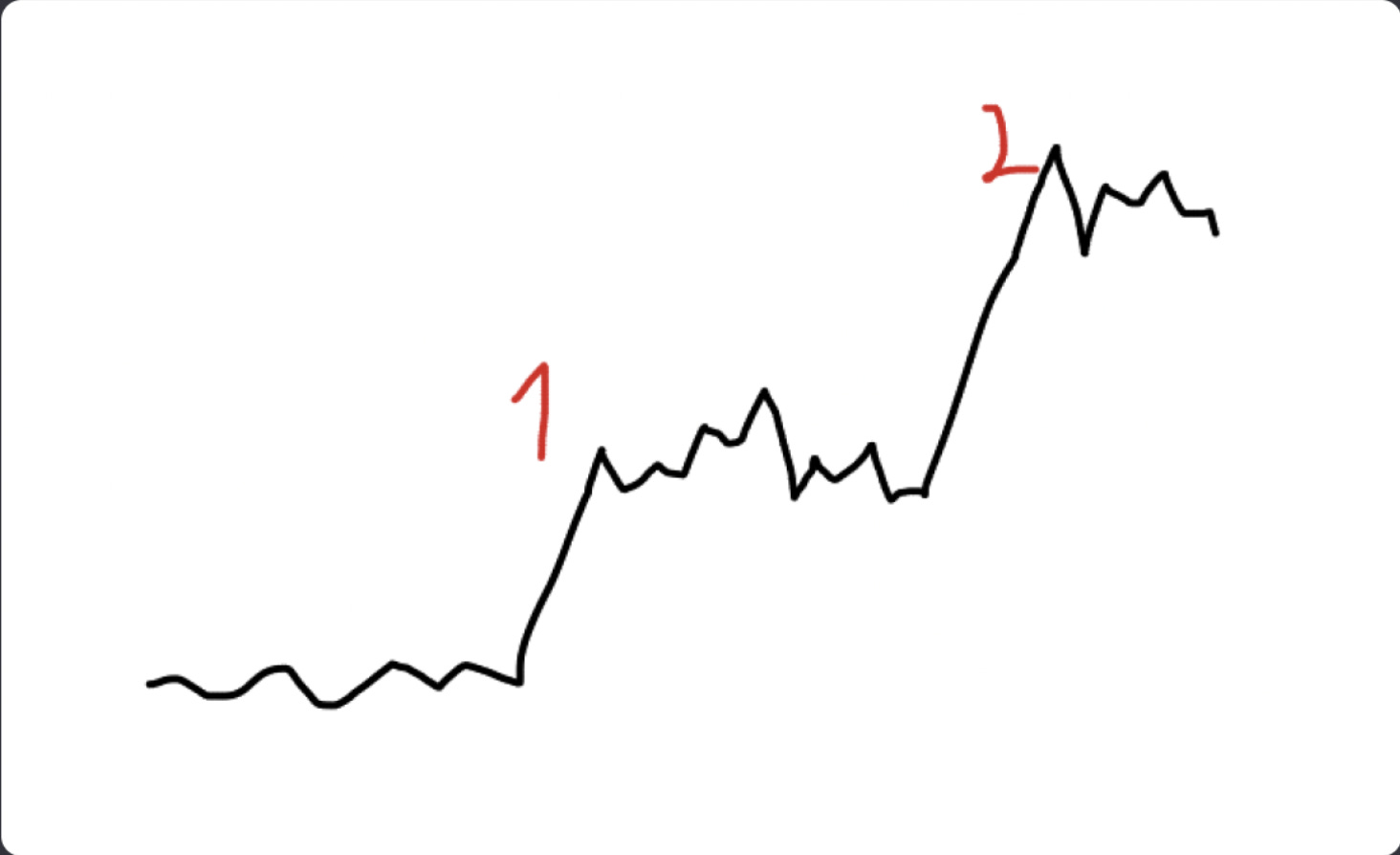
much like how the majority of a poker players lifetime earnings will be earned from a relatively few number of premium hands, these few outsized opportunities/edges will return most of your lifetime profit. in poker, when you have pocket aces, you don’t fold just because variance exists, you raise. this is the first reason for max allocating; trading often follows a similar power law distribution. a few events or periods will have outsized impacts on your pnl curve, and hence it is imperative to take advantage of opportunities that produce 1 and 2; i can count on one hand the opportunities that generated most of my capital. when a genuine asymmetric opportunity arises, treating it like an average one is irrational
big picture, only these phases matter, and everything that happens inbetween is noise. your whole curve is defined by a few moments. moments when you have edge. my definition of edge here varies. it can simply be a broad opportunity, such as being inside a certain regime structure, such as profitable solana memecoin traders during 2024 and 2025. they had no idea how long these onchain conditions would last, and it was clear to some of them that they had some form of edge. it can also be a specific, repeatable process, such as finding out a method to farm points in a cost efficient manner for a protocol airdrop that other users are unaware of.
but this is why, when you have it, it is crucial you take advantage. the reason why i write this article is because whilst this often seems like a simple thing to implement, many traders and market participants often struggle to realise when they have edge, and the timeframe of this edge. like my friend with his tiktok channel, some of them take it easy and assume their edge, or the conditions that provide their edge, will last forever. this is almost never the case.
the second reason for max allocating is because the opportunity might not last. for example, you might be able to farm points for $5 a point, whilst the project has an implied valuation of $25 a point, but this probably won’t always be a thing. more and more people will notice, and your edge will slowly decay. that’s the power of free markets. why would you ever allocate capital to your second or third-best opportunity when you have this better opportunity, which is also likely time-limited. when you identify an unusually large, high conviction edge or opportunity, you need to disproportionately allocate to it rather than dilute your allocation across inferior opportunities. make large, concentrated bets when you have conviction.
edge is often temporal. it is important that you identify if yours is, and if so, proceed to max extract. this was the crucial mistake my friend made, he misidentified the regime he was in and what his edge was, which prevented him from understanding the need to max extract. if you do not understand the game you are playing, how can you play it well? equally important is identifying when your edge has decayed. my friend anchored to his peak earnings, treating $1000/month as just insulting. aassuming you still have an edge after it has decayed, and acting like you still do, is one of the most counterproductive things you can do, basing allocation decisions on outdated information. for him, it is actively impeding him from making any money at all. in trading, it can mean you lose money.
“put all your eggs in one basket and watch the basket carefully.”
data from https://web.archive.org/web/20170307142828/http://www.pokerroom.com/poker/poker-school/ev-stats/total-stats-by-card/
*assuming you are trying to actively scale your book aggressively, ie running up a small amount, instead of trying to maintain wealth or slowly compound.
capital here doesn’t refer to money per se. in the case of my friend, capital was time, he should have been allocating as much time and effort during his peak earning potential. the same applies to solana trenchers, during good trenching conditions they should have allocated as many hours as physically possible to trenching (and the good ones did!). the definition of capital switches over to monetary when considering a specific trade, such as the example previously given, ie finding a way to harvest points at a low cost that other participants are unaware of, especially if this is a lot lower than premarket prices, what you can sell points for, or if in general you have high conviction in the project.